
Localization, Not Just Translation: Monthly Downloads in Japan Up About 60% on iOS for an Overseas Game App
When an app that is popular overseas enters Japan, the first thing most teams do is translate the store listing into Japanese.
But simply putting the text into Japanese does not guarantee that Japanese users will choose your app. This case study covers an overseas multiplayer social game app where we went beyond translation to “localization,” rebuilding the experience for Japan. Monthly downloads in Japan rose about 60% on iOS and about 20% on Android. We also saw ripple effects, including higher sales and a surge in installs coming from ChatGPT.
To protect the client’s information, the app name is withheld and results are shown only as multiples and percentages.
Case Summary
- Challenge: The store page and the app itself were mostly in English, so the app’s value was not reaching Japanese users
- Approach: Keyword design based on how people search in Japanese, A/B tests of Japanese screenshots, localization of in-app text and 50 games, and Japanese-language optimization including AIO
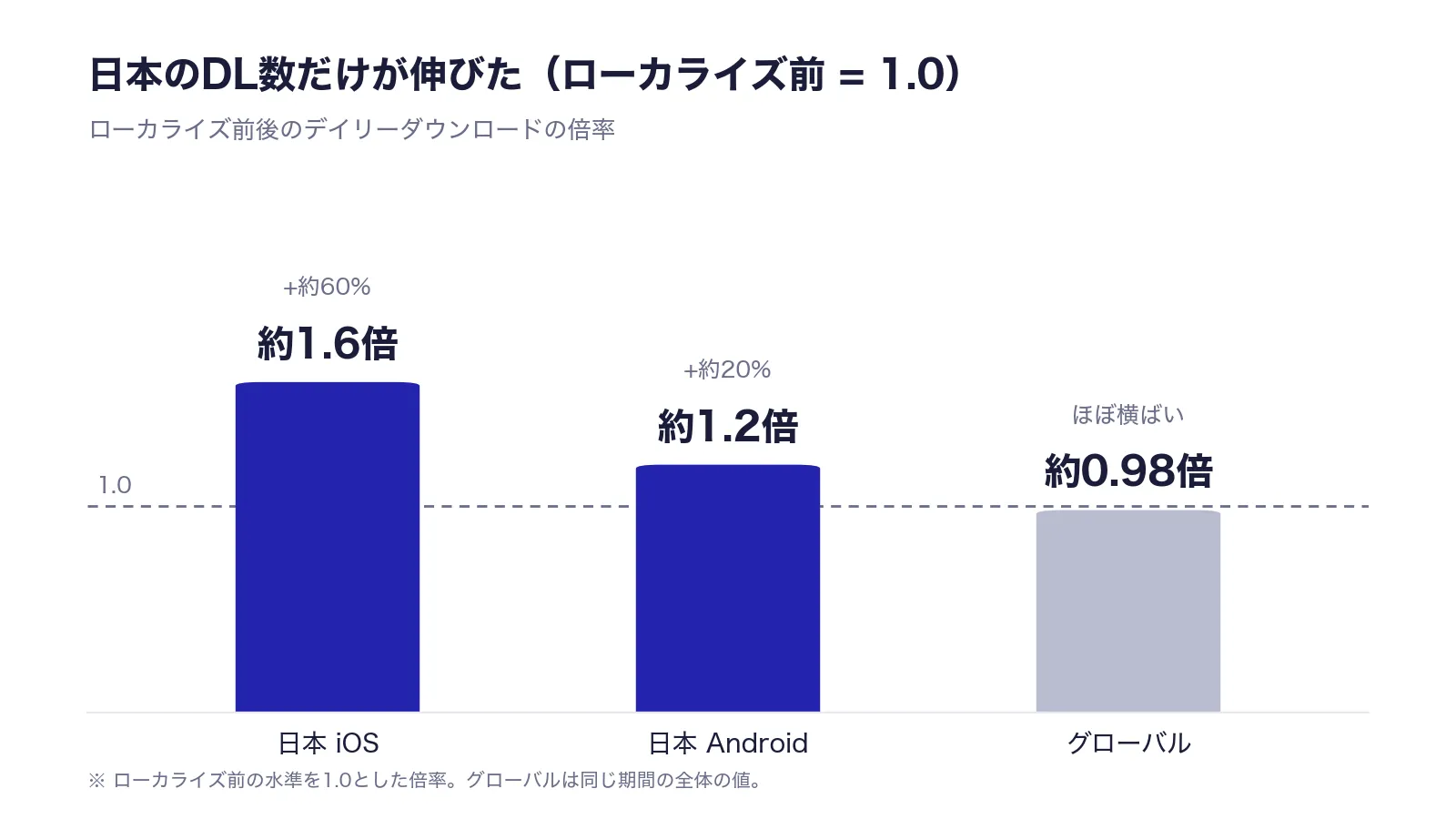
- Result: Daily downloads in Japan rose about 1.6x on iOS (about +60%) and about 1.2x on Android (about +20%). Over the same period, global downloads were about 0.98x, essentially flat
- Ripple effects: Average daily sales rose about 30%. Installs from ChatGPT on iOS grew about 3.4x
Challenge: Left in English, the App Gets Overlooked Before It Is Even Considered
This app is a multiplayer social game that people play together with friends. It was well received overseas, but in Japan the situation looked like this:
- The store title, keywords, and screenshots did not match how Japanese users search and what they prefer
- In-app text and game descriptions were still in English
- There was no numerical view of where Japan stood compared with the global market
Approach: Rebuilding Around How Japanese Users Behave, Not Just Translating
Over three months, we localized both the “store entry point” and the “in-app experience” as follows.
| Area | If we had only translated | What we did in this localization |
|---|---|---|
| Keywords | Replace English keywords with Japanese equivalents | Researched how Japanese users search, then designed the title, subtitle, and keyword field (iOS / Android) |
| Screenshots | Switch the text to Japanese | Created Japanese versions and confirmed through A/B tests that they outperformed the original page |
| In-app | Translate the text | Translated in-app text and 50 games, then checked the wording on real devices |
| Experience | Out of scope | Proposed optimizing onboarding and the tutorial |
| AIO | Out of scope | Made sure AI such as ChatGPT can understand, in Japanese, what the app is |
What we prioritized most was working backward from “what words Japanese users use to search, what they look at to decide, and how they start using the app.” For example, instead of relying only on branded searches, we designed the listing so the app can also be found through generic keywords that describe its genre.
Result: Only Japan Grew While the Global Figure Stayed Flat
Before and after localization, downloads in Japan grew as follows.
| Metric | iOS | Android |
|---|---|---|
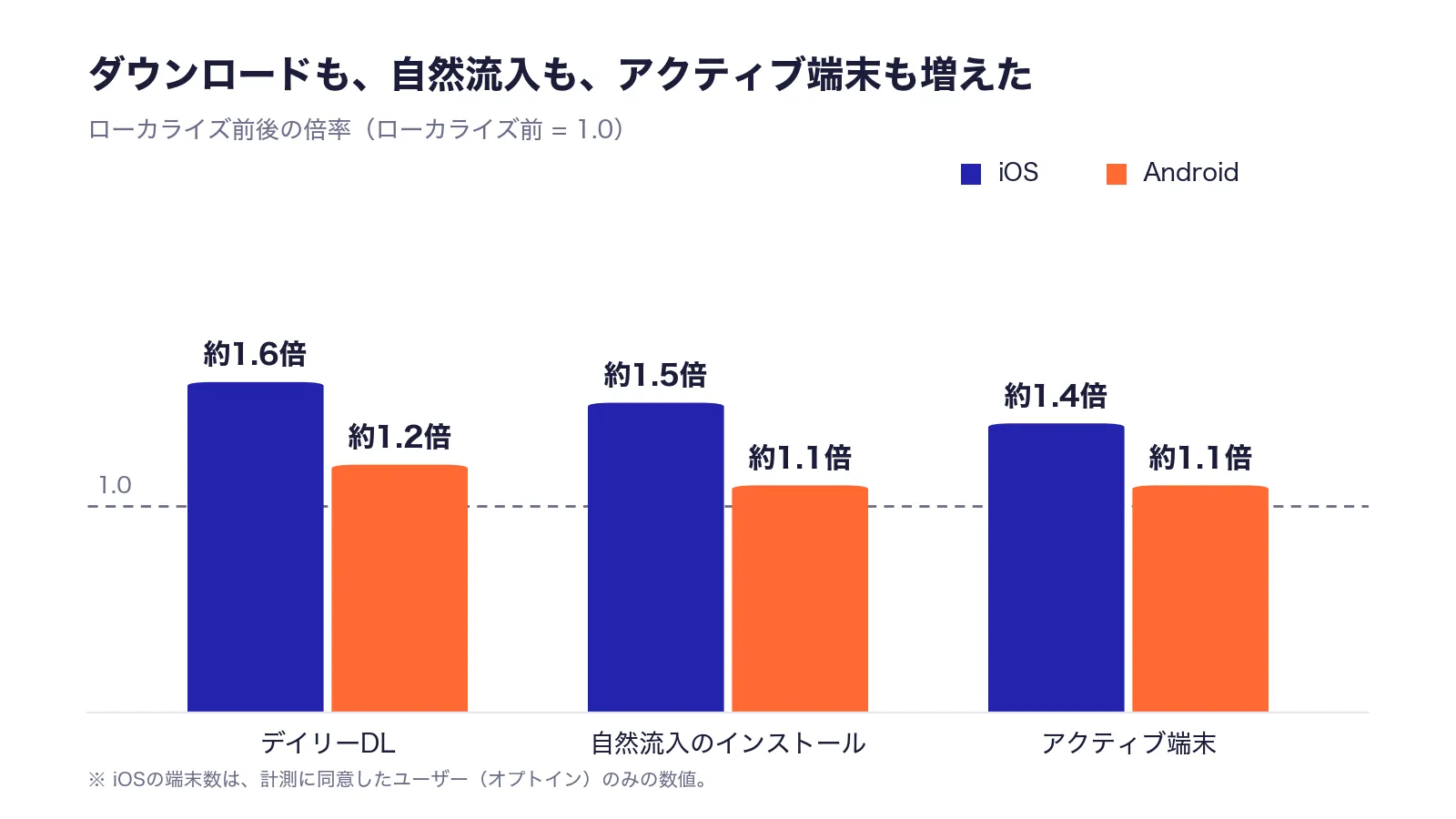
| Daily downloads | About 1.6x (about +60%) | About 1.2x (about +20%) |
| Organic installs (search + browse) | About 1.5x | About 1.1x |
| Active devices (daily average) | About 1.4x | About 1.1x |
iOS figures cover only users who consented to measurement (opt-in).
Over the same period, global downloads were about 0.98x, essentially flat, so this growth appears to be specific to Japan and driven by the Japan-focused improvements. Active devices also increased, confirming that the users who installed the app are actually opening it.
The following changes sit behind the growth.
- Right after the store listing update, search visibility (a metric calculated from each keyword’s search volume and rank) rose sharply on both iOS and Android, and installs from keywords ranked #1 increased on both platforms
- On iOS, the number of ranked keywords grew significantly. On Android, generic keywords other than the brand name came to account for about 40% of all installs
- In the A/B tests of Japanese screenshots, the new versions beat the original page on conversion rate on both iOS and Android. On iOS, the improvement over the English version is estimated at about +7.2%
Ripple Effect 1: Average Daily Sales Up About 30%
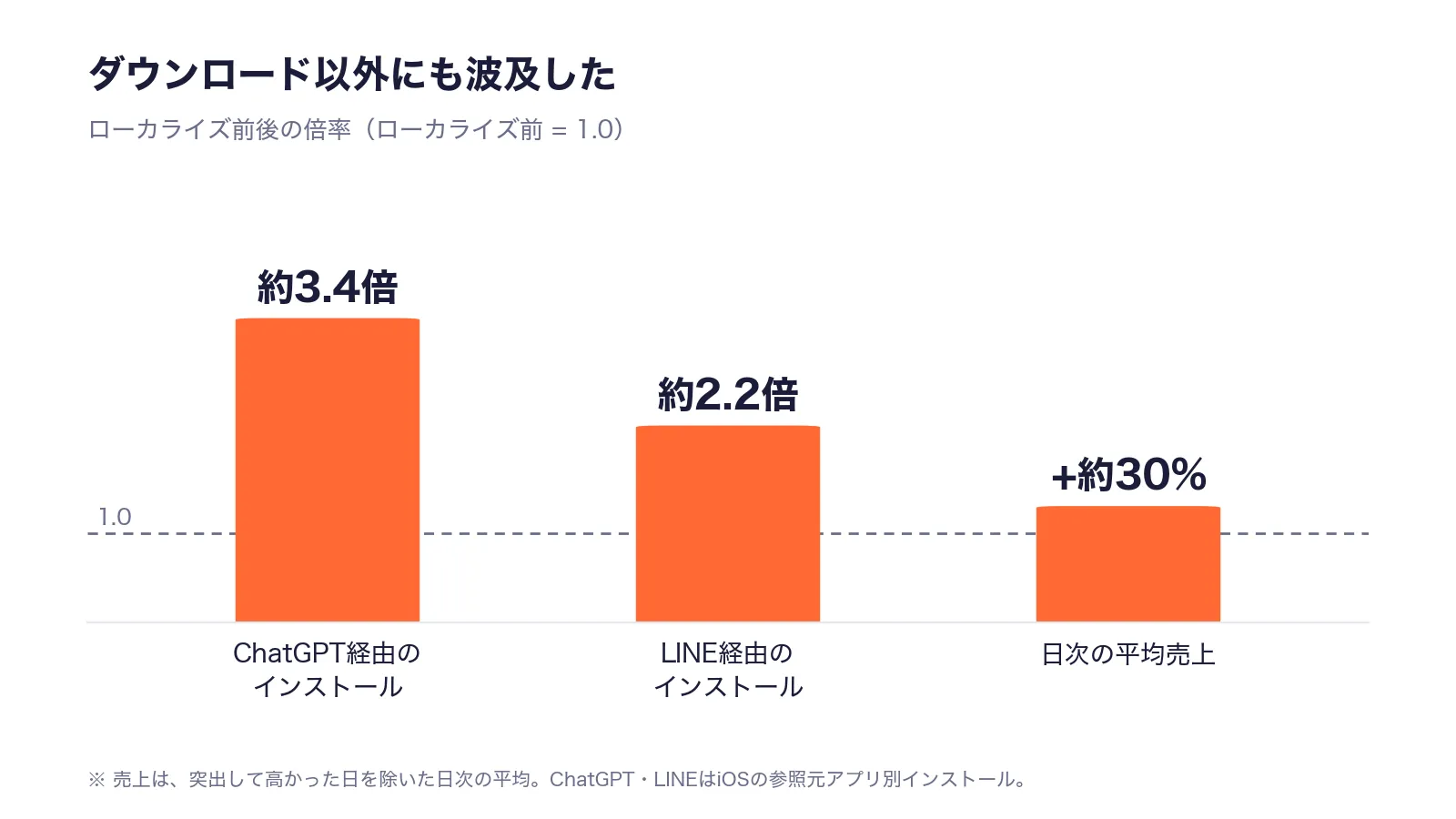
The growth in downloads also showed up in sales. Excluding unusually high days, average daily sales in Japan rose about 30% from before to after localization.
Ripple Effect 2: Installs from ChatGPT Up About 3.4x
Another change came from sources other than search. Looking at iOS installs by referring app, the figures before and after the store listing update grew as follows.
- Installs from ChatGPT: about 3.4x
- Installs from LINE: about 2.2x
The ChatGPT path is a new route in which the app gets recommended when a user asks AI, “What games can I play with friends?” As an organic source that can grow without relying on ads, it will only become more important.
For AI to recommend an app, it must first be clear, in Japanese, exactly what the app is. Advancing localization and AIO together appears to have driven this growth. The rise in LINE installs reflects word of mouth, with friends sharing links, which suits a game played with friends.
What This Case Shows
1. “Translation” and “localization” are different things
The reason only Japan grew while the global figure stayed flat is that we did not just swap English for Japanese. We rebuilt the experience around how Japanese users search, choose, and use an app.
2. The effects of localization extend beyond downloads
On top of the download growth, the effects reached sales and installs from AI such as ChatGPT. Rather than working on the store, the app, and AIO separately, it is important to make the app look consistent and clear to Japanese users throughout.
3. Design with what comes after acquisition in mind
Once the entry point is in place, the next challenges are retaining and monetizing the users you acquire. In this project too, we are moving into the next phase of improvements, such as localizing the purchase page and designing the path to a first purchase.
If you are considering entering Japan with an overseas app, or localization that includes ASO and AIO, please feel free to contact us.
FAQ
Q. Isn't translating the store listing enough?
A. Translation swaps English for Japanese. Localization rebuilds the experience around how Japanese users search, choose, and use an app. In this case we researched how people search in Japanese to design the keywords, validated the screenshots with A/B tests, and checked the in-app wording on real devices. As a result, downloads grew only in Japan while the global figure stayed flat.
Q. Does localization affect anything besides downloads?
A. es. In this case, alongside the download growth, we saw an increase in sales and growth in installs from ChatGPT. Once the store page and the app itself communicated clearly in Japanese, the effect appears to have spread beyond search to other acquisition paths and to revenue.
Q. What can we do to get our app recommended by AI such as ChatGPT?
A. I recommends apps that match a user's question based on information from store pages and the web, so the first requirement is that it is clear, in Japanese, what your app is. In this case, after we localized into Japanese and worked on AIO (AI search optimization), installs from ChatGPT grew about 3.4x.